

Hanuman Chalisa Decoded — Every Line Explained in Hindi & English for Today’s Seekers
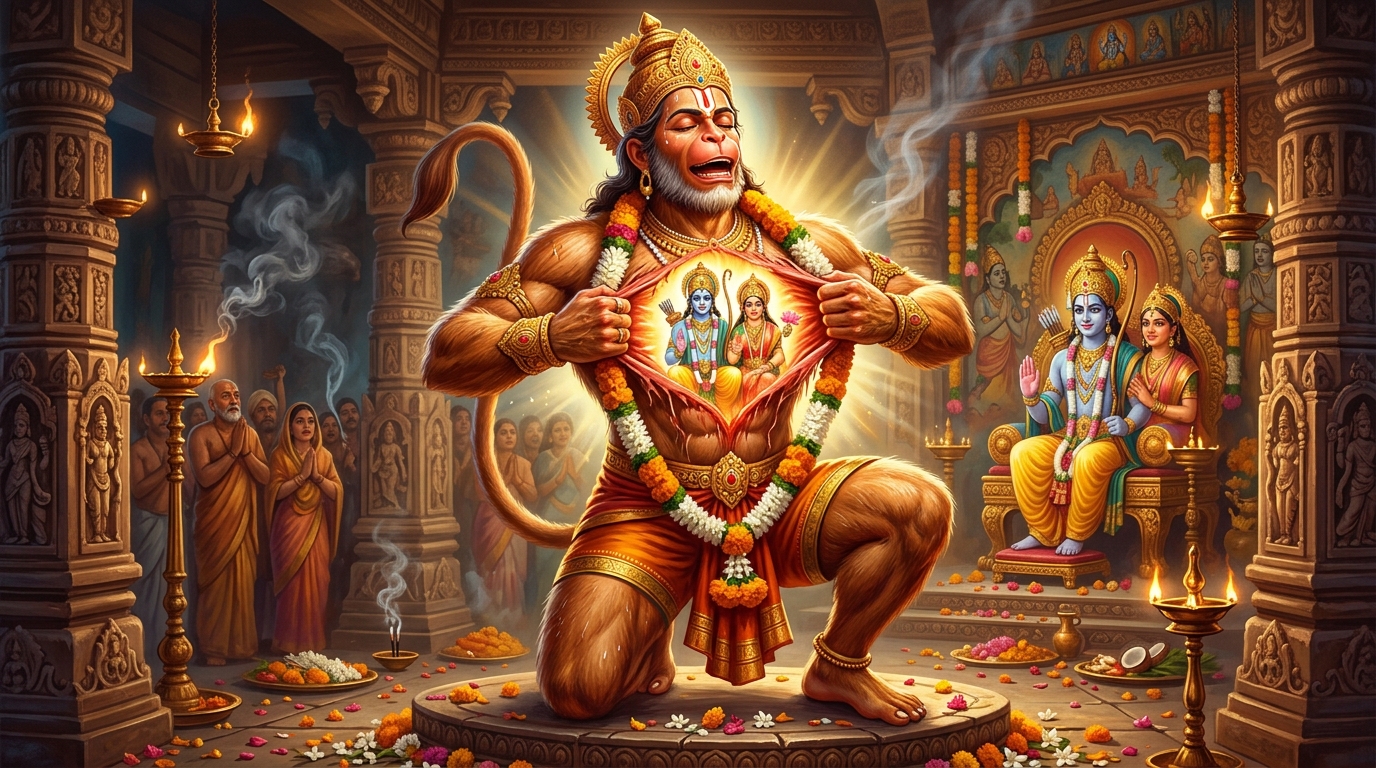
🙏 The Hanuman Chalisa is not just a prayer — it is a spiritual technology. Composed by the great saint-poet Goswami Tulsidas over 500 years ago, each of its 40 verses (chaupais) functions like a mahamantra — a master key that unlocks courage, wisdom, and liberation. As Neem Karoli Baba said: “Each line of the Hanuman Chalisa is like a mahamantra.” In this definitive 2026 guide, we decode every single line — in both Hindi and English — through the lens of story, psychology, and Vedantic wisdom that modern seekers can apply to daily life.
🙏 What Is the Hanuman Chalisa? Why Does It Matter in 2026?
The word “Chalisa” comes from the Hindi word chalis meaning forty. The Hanuman Chalisa is a devotional hymn of 40 chaupais (quatrains) plus 2 dohas (couplets) — one at the beginning and one at the end. Written in the Awadhi dialect of Hindi by Goswami Tulsidas (1511–1623 CE), it captures the entire essence of Lord Hanuman’s devotion to Lord Rama, his superhuman strength, and his role as the destroyer of obstacles.
But the Hanuman Chalisa is far more than a religious text. As Acharya Prashant explains in his Vedantic interpretation: “The Hanuman Chalisa is meant to cut your inner ignorance — to liberate you from bondages.” For the modern professional battling anxiety, imposter syndrome, or existential doubt, this 500-year-old prayer holds surprisingly relevant answers.
Before we understand Hanuman, we must understand who Ram is. Tulsidas himself answers this question clearly: राम ब्रह्म परमार्थ रूप — Ram is Brahman, the Ultimate Truth. Ram is not merely a historical king — Ram represents the highest consciousness, the Paramatma that resides within every heart. When Hanuman serves Ram, he is serving this highest Truth. This understanding transforms the entire Chalisa from mere devotion into a roadmap for spiritual awakening.
📜 The Opening Doha — Purifying the Inner Mirror
The Hanuman Chalisa begins not with Hanuman, but with the Guru. This is profound — before you can approach the divine, you must first cleanse the instrument of perception: your own mind.
🔶 दोहा १ | Doha 1 — The Guru’s Grace
श्री गुरु चरण सरोज रज, निज मनु मुकुरु सुधारि।
बरनऊं रघुबर बिमल जसु, जो दायकु फल चारि॥
Shri Guru Charan Saroj Raj, Nij Manu Mukuru Sudhari,
Barnau Raghubar Bimal Jasu, Jo Dayaku Phal Chari.
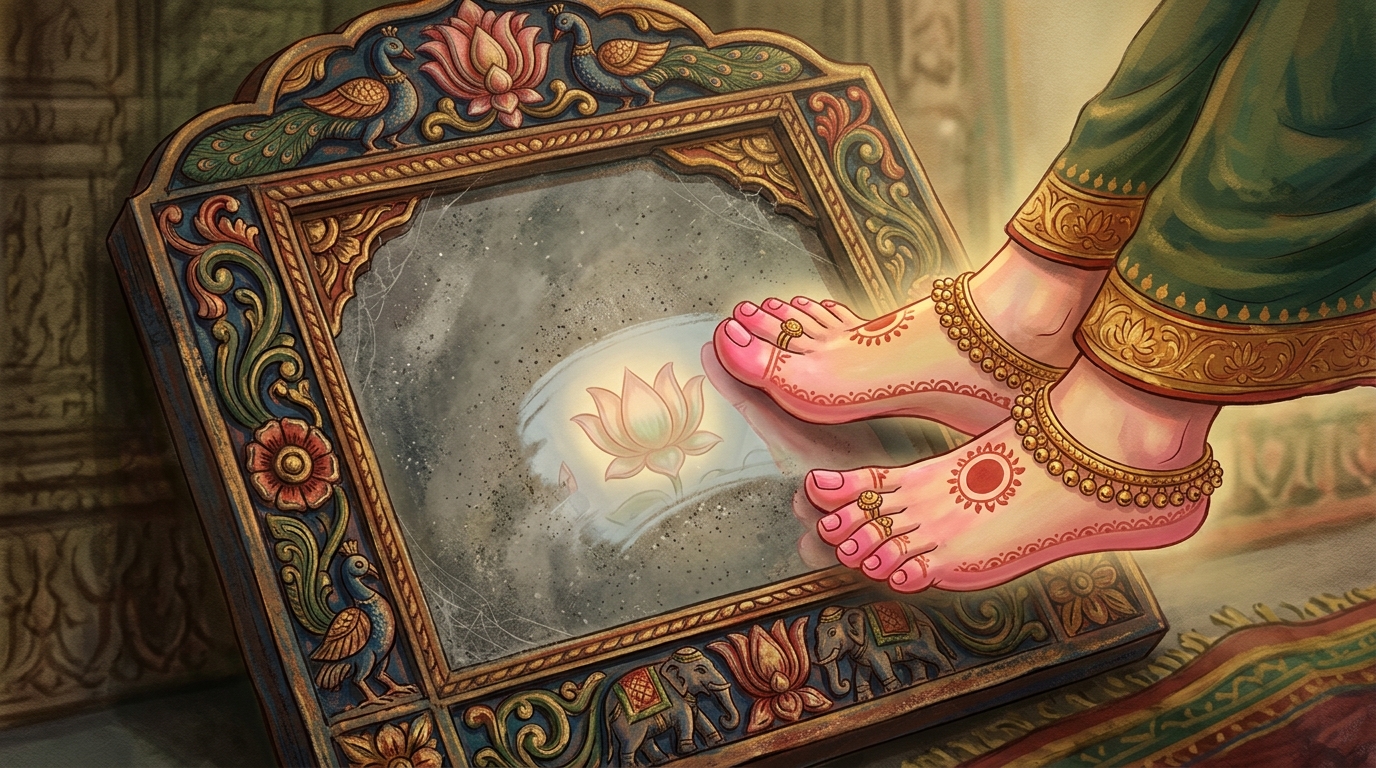
📖 Line 1: श्री गुरु चरण सरोज रज, निज मनु मुकुरु सुधारि
“With the dust of my Guru’s lotus feet, I cleanse the mirror of my mind.”
🔍 Story-Based Decoding: Imagine your mind as an ancient mirror covered in years of dust — the dust of ego, fear, desire, and conditioning. You cannot see your true reflection in it. The Guru’s feet are described as lotus (saroj) — a lotus grows in mud but remains untouched by it. Similarly, the Guru lives in this world but remains untouched by its illusions. The raj (dust) from such feet becomes the most powerful cleansing agent for your inner mirror. In Sanskrit, Gu means darkness and Ru means the remover of that darkness. The Guru is literally the one who removes ignorance.
💡 Modern Application: Before starting any important endeavor — a new job, a relationship, a creative project — first clear your mental lens. Seek wisdom from those who have walked the path before you. Without mental clarity, even the best opportunities will appear distorted.
📖 Line 2: बरनऊं रघुबर बिमल जसु, जो दायकु फल चारि
“I sing the pure glory of Lord Rama (the best of the Raghu dynasty), which bestows the four fruits of life.”
🔍 Decoding: The four fruits (Phal Chari) are the Purusharthas — the four aims of human existence in Sanatan Dharma: Dharma (righteous duty), Artha (wealth and prosperity), Kama (desire and fulfillment), and Moksha (liberation). By singing the glory of Ram — which means by aligning yourself with the highest truth — all four dimensions of a complete life naturally fulfill themselves.
🔶 दोहा २ | Doha 2 — The Humble Seeker
बुद्धिहीन तनु जानिके, सुमिरौं पवन कुमार।
बल बुद्धि विद्या देहु मोहिं, हरहु कलेश विकार॥
Buddhiheen Tanu Janike, Sumirau Pavan Kumar,
Bal Buddhi Vidya Dehu Mohi, Harahu Kalesh Vikar.
📖 Line 1: बुद्धिहीन तनु जानिके, सुमिरौं पवन कुमार
“Knowing myself to be limited in intellect, I remember you, O Son of the Wind (Hanuman).”
🔍 Decoding: This is the most important spiritual prerequisite — intellectual humility. Tulsidas, one of the greatest poets India has ever produced, calls himself buddhiheen (intellectually limited). This is not false modesty — it is the recognition that the rational mind alone cannot grasp the infinite. The moment you acknowledge the limitation of your intellect, you open the door to a higher intelligence. Pavan Kumar (Son of the Wind) — Hanuman is the child of Vayu, the life-force itself. By invoking Hanuman, you are invoking prana, the vital energy that transcends intellectual limitations.
📖 Line 2: बल बुद्धि विद्या देहु मोहिं, हरहु कलेश विकार
“Grant me strength, wisdom, and knowledge, and remove all my afflictions and impurities.”
🔍 Decoding: Three things are requested: Bal (strength — physical and mental resilience), Buddhi (wisdom — the capacity for right discernment), and Vidya (knowledge — both worldly and spiritual). And one thing is requested to be removed: Kalesh Vikar (afflictions and distortions of the mind). This is the complete formula for a fulfilled life — gain what is necessary, release what is toxic.
🙏 The 40 Chaupais — Verse-by-Verse Deep Decoding
Now begins the heart of the Chalisa — 40 verses that tell the complete story of Hanuman’s glory, from his divine attributes to his legendary deeds, culminating in the promise of liberation for anyone who recites them with devotion.
🔸 चौपाई १ | Chaupai 1
जय हनुमान ज्ञान गुन सागर। जय कपीस तिहुँ लोक उजागर॥
Jai Hanuman Gyan Gun Sagar, Jai Kapees Tihun Lok Ujagar.
“Victory to Hanuman, the ocean of wisdom and virtue. Victory to the Lord of monkeys, who illuminates the three worlds.”
🔍 Decoding: The very first verse calls Hanuman a sagar (ocean) — not a pond, not a river, but an ocean of wisdom. As Acharya Prashant explains, when Tulsidas uses the word gyan (knowledge) for Hanuman, he means Vedantic knowledge — the knowledge of Brahman, of the Self. Tihun Lok Ujagar — the three worlds (physical, astral, and causal) are illuminated by Hanuman’s presence. Just as the sun illuminates the earth, a being established in Truth illuminates all dimensions of existence.
🔸 चौपाई २ | Chaupai 2
राम दूत अतुलित बल धामा। अंजनि पुत्र पवन सुत नामा॥
Ram Doot Atulit Bal Dhama, Anjani Putra Pavan Sut Nama.
“The messenger of Lord Rama, the abode of incomparable strength. Son of Anjani, named the Son of the Wind.”
🔍 Decoding: Hanuman’s identity is defined through his relationships — he is Ram’s doot (messenger), Anjani’s putra (son), and Pavan’s sut (child). His strength is atulit — beyond comparison. The modern lesson: your strength comes from your connections and your sense of purpose. When you serve something greater than yourself, you access reserves of power you never knew existed.
🔸 चौपाई ३ | Chaupai 3
महाबीर बिक्रम बजरंगी। कुमति निवार सुमति के संगी॥
Mahabir Bikram Bajrangi, Kumati Nivar Sumati Ke Sangi.
“O great hero of tremendous valor, with a body as strong as a thunderbolt. You dispel evil thoughts and are the companion of noble intellect.”
🔍 Decoding: Bajrangi — one whose limbs (ang) are like a thunderbolt (bajra). But the real power statement is the second line: Hanuman removes bad thoughts (kumati nivar) and accompanies good ones (sumati ke sangi). He does not fight evil externally — he transforms the inner landscape. For the modern seeker, this means: true strength is not in overpowering others, but in mastering your own mind.
🔸 चौपाई ४ | Chaupai 4
कंचन बरन बिराज सुबेसा। कानन कुंडल कुंचित केसा॥
Kanchan Baran Biraj Subesa, Kanan Kundal Kunchit Kesa.
“Your golden complexion shines magnificently. You wear earrings and have beautiful curly hair.”
🔍 Decoding: Gold (kanchan) in Vedic symbolism represents purity, permanence, and divinity. Hanuman’s golden form signifies a purified consciousness — one that has been tested in the fire of devotion and emerged pure. The earrings (kundal) symbolize wisdom received from the Guru through the ears (the seat of learning in Indian tradition).
🔸 चौपाई ५ | Chaupai 5
हाथ बज्र और ध्वजा बिराजे। काँधे मूँज जनेऊ साजे॥
Hath Bajra Aur Dhvaja Biraje, Kandhe Moonj Janeu Saje.
“In your hands shine the thunderbolt and the flag. A sacred thread of munja grass adorns your shoulder.”
🔍 Decoding: The bajra (mace/thunderbolt) represents the power to destroy obstacles. The dhvaja (flag) represents victory and sovereignty. The sacred thread (janeu) of munja grass shows Hanuman as a Brahmin — a knower of Brahman. He embodies both the warrior’s strength and the scholar’s wisdom — the ideal synthesis for the modern professional.
🔸 चौपाई ६ | Chaupai 6
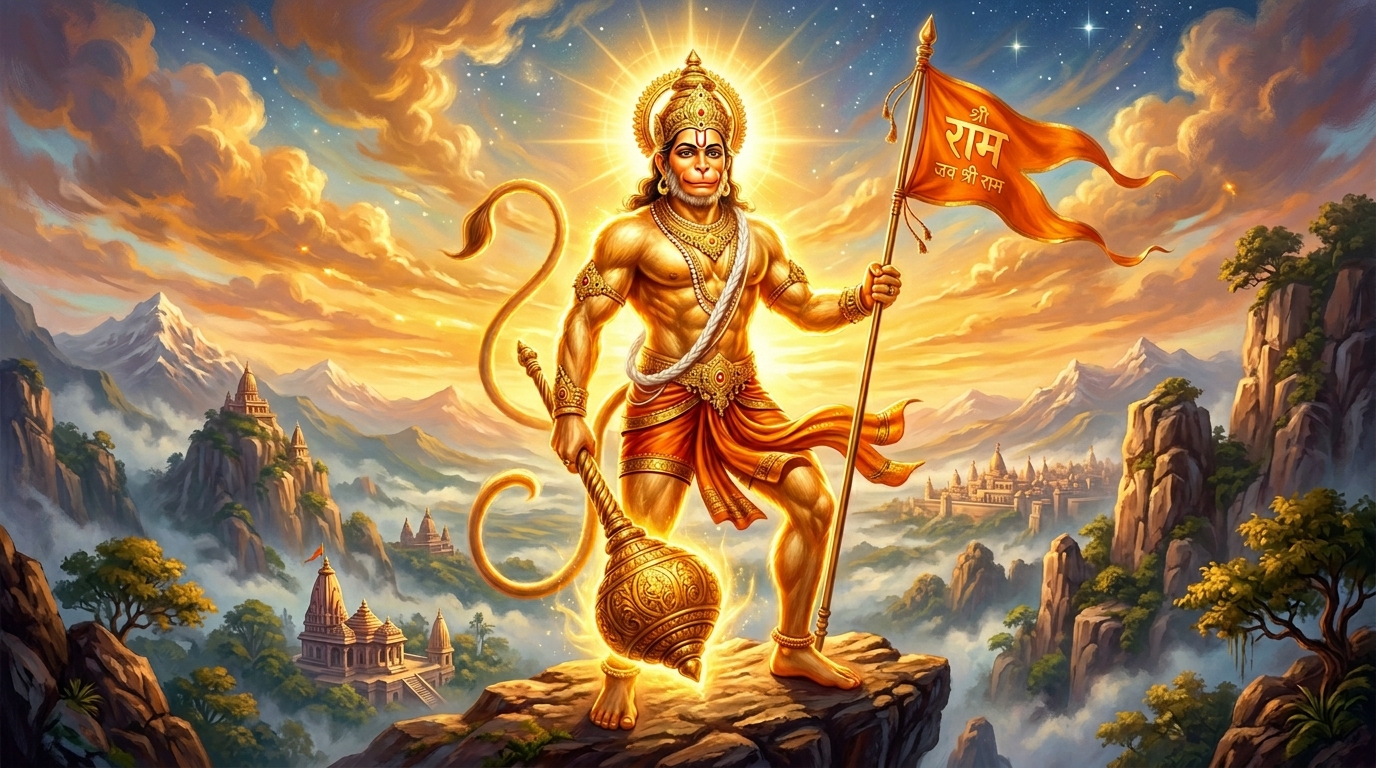
शंकर सुवन केसरी नंदन। तेज प्रताप महा जग बंदन॥
Shankar Suvan Kesari Nandan, Tej Pratap Maha Jag Bandan.
“You are an incarnation of Lord Shiva, son of Kesari. The whole world worships your magnificent radiance and valor.”
🔍 Decoding: Hanuman is called Shankar Suvan — a manifestation of Shiva himself. This connects Hanuman to the cosmic principle of destruction and renewal. His tej (radiance) is not external beauty but inner luminosity — the glow of a consciousness that has conquered fear and desire.
🔸 चौपाई ७ | Chaupai 7
विद्यावान गुणी अति चातुर। राम काज करिबे को आतुर॥
Vidyavan Guni Ati Chatur, Ram Kaj Karibe Ko Aatur.
“You are learned, virtuous, and supremely clever. You are ever eager to accomplish Lord Rama’s work.”
🔍 Decoding: Aatur — this word is electric. It means restlessly eager, burning with purpose. Hanuman does not serve Ram out of obligation — he does it with aatur, with passionate urgency. This is the secret of fulfillment: find your Ram’s work, and pursue it with such intensity that rest feels like a delay. In 2026, this is the antidote to burnout — not less work, but work aligned with your deepest purpose.
🔸 चौपाई ८ | Chaupai 8
प्रभु चरित्र सुनिबे को रसिया। राम लखन सीता मन बसिया॥
Prabhu Charitra Sunibe Ko Rasiya, Ram Lakhan Sita Man Basiya.
“You delight in listening to the Lord’s divine stories. Rama, Lakshmana, and Sita dwell in your heart.”
🔍 Decoding: Rasiya — one who relishes, who finds rasa (essence/juice) in something. Hanuman is not a passive listener — he savors every story of Ram the way a connoisseur savors fine art. When Ram, Lakhan, and Sita reside in your heart, it means Truth, Loyalty, and Devotion have made their permanent home within you.
🔸 चौपाई ९–१० | Chaupai 9-10
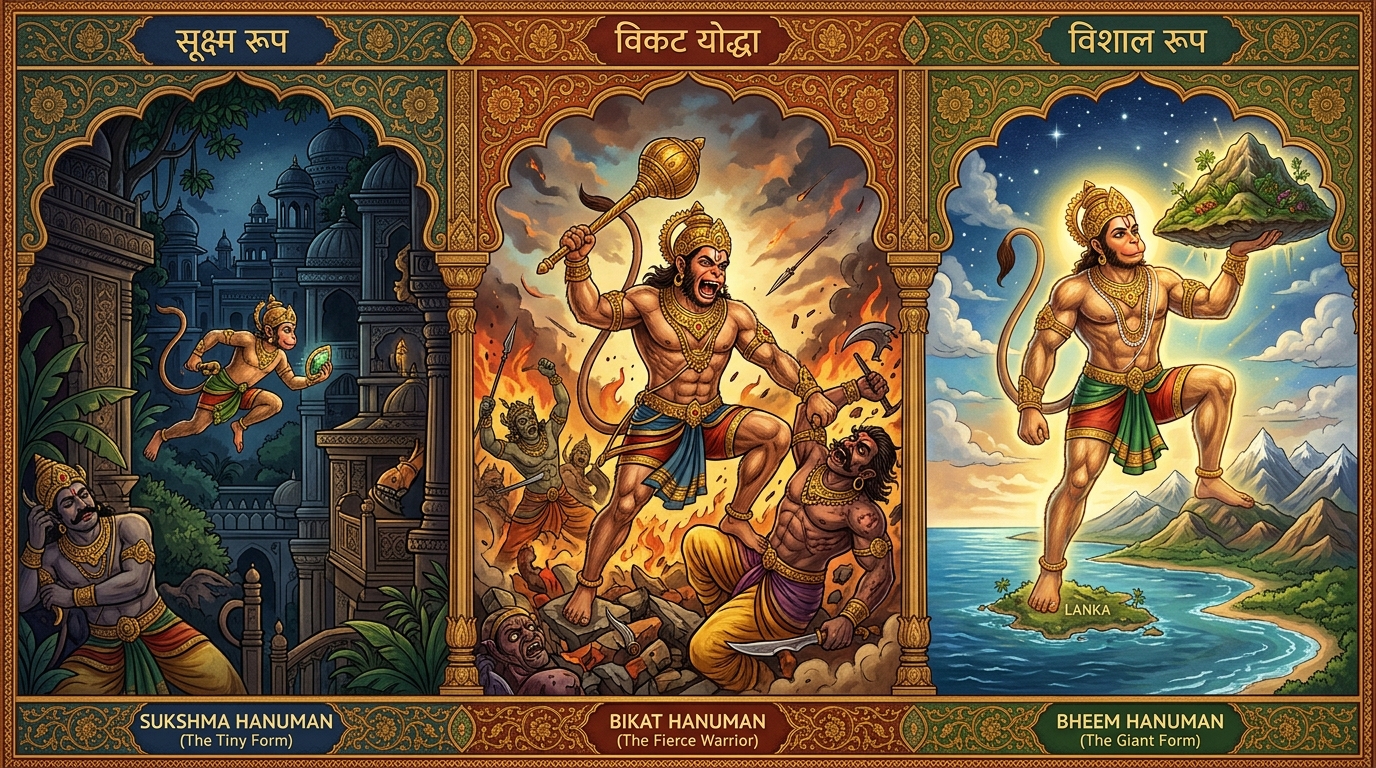
सूक्ष्म रूप धरि सियहिं दिखावा। बिकट रूप धरि लंक जरावा॥
भीम रूप धरि असुर संहारे। रामचंद्र के काज संवारे॥
Sukshma Roop Dhari Siyahin Dikhava, Bikat Roop Dhari Lanka Jarava.
Bheem Roop Dhari Asur Samhare, Ramchandra Ke Kaj Sanvare.
“You appeared before Sita in a tiny form. In a terrifying form, you burned Lanka.
In a mighty form, you destroyed demons. You accomplished all of Lord Rama’s missions.”
🔍 Decoding: Three forms — sukshma (subtle/tiny), bikat (terrifying), and bheem (mighty). Hanuman adapts his form to the need of the moment: gentle when meeting the frightened Sita, fearsome when burning Lanka, powerful when fighting demons. This is situational intelligence — the ability to modulate your energy based on context. A good leader knows when to whisper and when to roar.
🔸 चौपाई ११–१२ | Chaupai 11-12
लाय सजीवन लखन जियाये। श्री रघुबीर हरषि उर लाये॥
रघुपति कीन्ही बहुत बड़ाई। तुम मम प्रिय भरत हि सम भाई॥
Lai Sajivan Lakhan Jiyaye, Shri Raghubir Harashi Ur Laye.
Raghupati Kinhi Bahut Badai, Tum Mama Priya Bharat Hi Sam Bhai.
“You brought the Sanjeevani herb and revived Lakshmana. Lord Rama embraced you with great joy.
Lord Rama praised you greatly and said — You are as dear to me as my brother Bharata.”
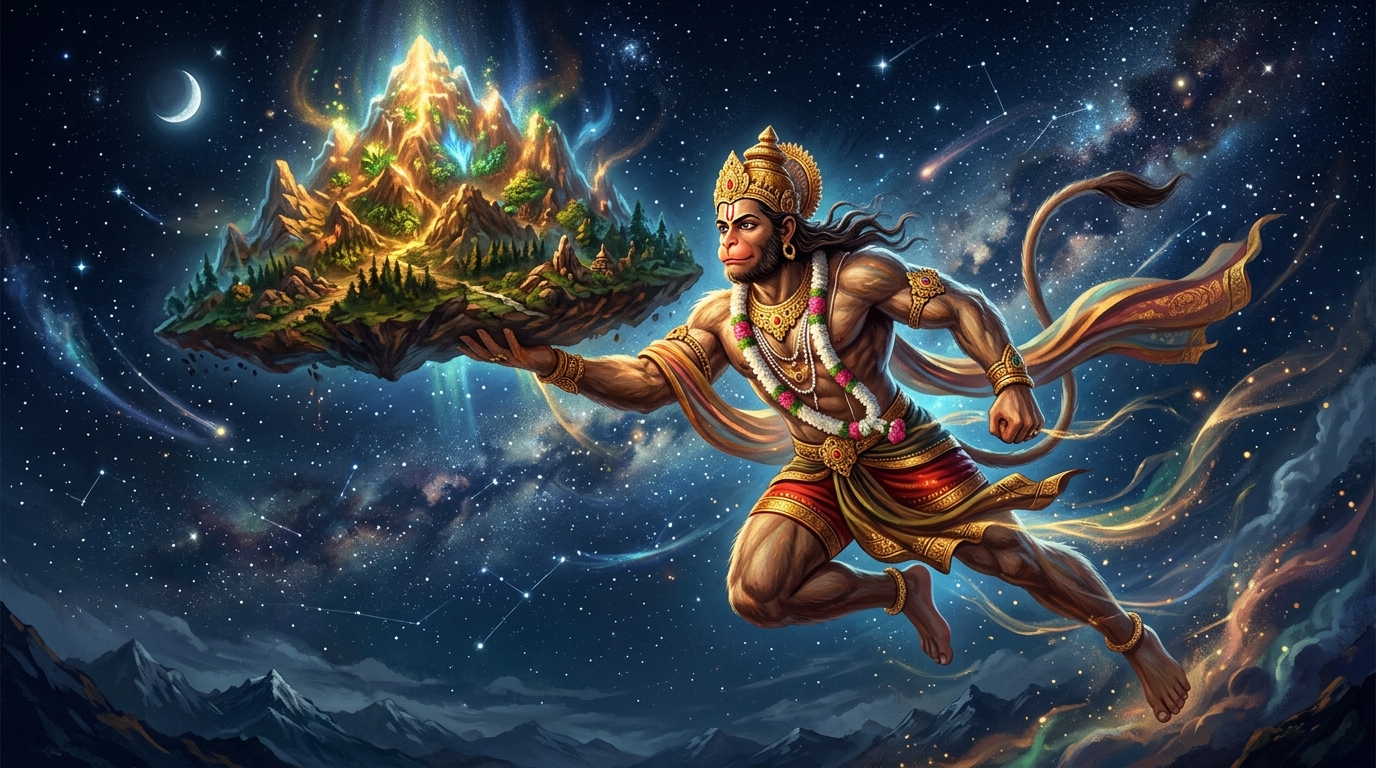
🔍 Decoding: This is the legendary story of Hanuman flying to the Himalayas to bring the Sanjeevani herb when Lakshmana lay dying. Unable to identify the exact herb, Hanuman lifted the entire mountain. The message: when someone you love is in crisis, do not calculate the minimum viable effort. Give everything. Bring the whole mountain. Ram’s comparison of Hanuman to Bharata — his own blood brother — shows that devotion creates bonds deeper than biology.
🔸 चौपाई १३–१५ | Chaupai 13-15
सहस बदन तुम्हरो जस गावैं। अस कहि श्रीपति कंठ लगावैं॥
सनकादिक ब्रह्मादि मुनीसा। नारद सारद सहित अहीसा॥
जम कुबेर दिगपाल जहाँ ते। कबि कोबिद कहि सके कहाँ ते॥
Sahas Badan Tumharo Jas Gavein, As Kahi Shripati Kanth Lagavein.
Sanakadik Brahmadi Muneesa, Narad Sarad Sahit Aheesa.
Yam Kuber Digpal Jahan Te, Kabi Kobid Kahi Sake Kahan Te.
“Saying this, the Lord embraced you, declaring that even the thousand-headed serpent (Shesha) sings your glory. Sages like Sanaka, Brahma, Narada, Saraswati, and Sheshnag — even Yama, Kubera, and the guardians of the directions — no poet or scholar can fully describe your greatness.”
🔍 Decoding: When the highest beings in the cosmic hierarchy — from Brahma the creator to Sheshnag the cosmic serpent — cannot fully describe Hanuman’s glory, it tells us something profound: true spiritual greatness is beyond verbal description. It must be experienced. No LinkedIn post can capture a life truly devoted to purpose.
🔸 चौपाई १६–२० | Chaupai 16-20
तुम उपकार सुग्रीवहिं कीन्हा। राम मिलाय राज पद दीन्हा॥
तुम्हरो मंत्र विभीषण माना। लंकेश्वर भये सब जग जाना॥
जुग सहस्त्र जोजन पर भानू। लील्यो ताहि मधुर फल जानू॥
प्रभु मुद्रिका मेलि मुख माहीं। जलधि लाँघि गये अचरज नाहीं॥
दुर्गम काज जगत के जेते। सुगम अनुग्रह तुम्हरे तेते॥
Tum Upkar Sugreevahin Keenha… Durgam Kaj Jagat Ke Jete, Sugam Anugrah Tumhre Tete.
🔍 Key Decoding of Verse 18: “Jug Sahastra Jojan Par Bhanu, Leelyo Tahi Madhur Phal Janu” — The sun, which is at a distance of jug sahastra jojan (billions of yojanas), you swallowed it thinking it was a sweet fruit. As a child, Hanuman leapt towards the sun, mistaking it for a ripe mango. This is the innocence of a pure heart combined with impossible courage — the willingness to reach for what seems unreachable.

🔍 Key Decoding of Verse 20: “Durgam Kaj Jagat Ke Jete, Sugam Anugrah Tumhre Tete” — All the impossible tasks of the world become easy with your grace. This is the central promise of the Hanuman Chalisa: whatever obstacle seems insurmountable to you, Hanuman’s grace makes it sugam (easy). Not through magic — through the courage, wisdom, and devotion he embodies.
🔸 चौपाई २१–२५ | Chaupai 21-25
राम दुआरे तुम रखवारे। होत न आज्ञा बिनु पैसारे॥
सब सुख लहैं तुम्हारी सरना। तुम रक्षक काहू को डरना॥
आपन तेज सम्हारो आपे। तीनों लोक हांक ते कांपे॥
भूत पिसाच निकट नहिं आवे। महाबीर जब नाम सुनावे॥
नासै रोग हरे सब पीरा। जपत निरंतर हनुमत बीरा॥
🔍 Decoding (Verse 21): “Ram Duare Tum Rakhvare” — You are the gatekeeper at Ram’s door. No one enters without your permission. This means: to access the highest Truth (Ram), you must first pass through devotion (Hanuman). There is no shortcut to spiritual realization that bypasses sincere devotion and service.
🔍 Decoding (Verse 22): “Sab Sukh Lahai Tumhari Sarna” — All happiness is found in your refuge. When you have a protector, what is there to fear? In modern terms: when you have a clear purpose and unwavering values, external chaos cannot disturb your inner peace.
🔍 Decoding (Verse 25): “Nasai Rog Hare Sab Peera” — All diseases vanish, all pain is destroyed by constantly chanting Hanuman’s name. This is not superstition — repetitive devotional chanting (japa) has been shown by modern neuroscience to reduce cortisol levels, calm the autonomic nervous system, and promote healing. Ancient wisdom, scientific validation.
🔸 चौपाई २६–३० | Chaupai 26-30
संकट ते हनुमान छुड़ावे। मन क्रम बचन ध्यान जो लावे॥
सब पर राम तपस्वी राजा। तिन के काज सकल तुम साजा॥
और मनोरथ जो कोई लावे। सोई अमित जीवन फल पावे॥
चारों जुग परताप तुम्हारा। है परसिद्ध जगत उजियारा॥
साधु संत के तुम रखवारे। असुर निकंदन राम दुलारे॥
🔍 Decoding (Verse 26): “Sankat Te Hanuman Chhudave, Man Kram Bachan Dhyan Jo Lave” — Hanuman liberates from all crises those who remember him through man (mind), kram (action), and bachan (speech). This is the Trikarana Shuddhi — the alignment of thought, word, and deed. When these three are synchronized in devotion, no crisis can survive.
🔍 Decoding (Verse 29): “Charon Jug Partap Tumhara” — Your glory extends across all four yugas (ages). Hanuman is chiranjeevi (immortal) — he exists in every age. The principle Hanuman represents — selfless devotion to Truth — is timeless. It was relevant 500 years ago, and it is relevant in the age of AI and quantum computing.
🔸 चौपाई ३१–३५ | Chaupai 31-35
अष्ट सिद्धि नौ निधि के दाता। अस बर दीन्ह जानकी माता॥
राम रसायन तुम्हरे पासा। सदा रहो रघुपति के दासा॥
तुम्हरे भजन राम को पावे। जनम जनम के दुख बिसरावे॥
अंत काल रघुबर पुर जाई। जहाँ जन्म हरि भक्त कहाई॥
और देवता चित्त न धरई। हनुमत सेई सर्ब सुख करई॥
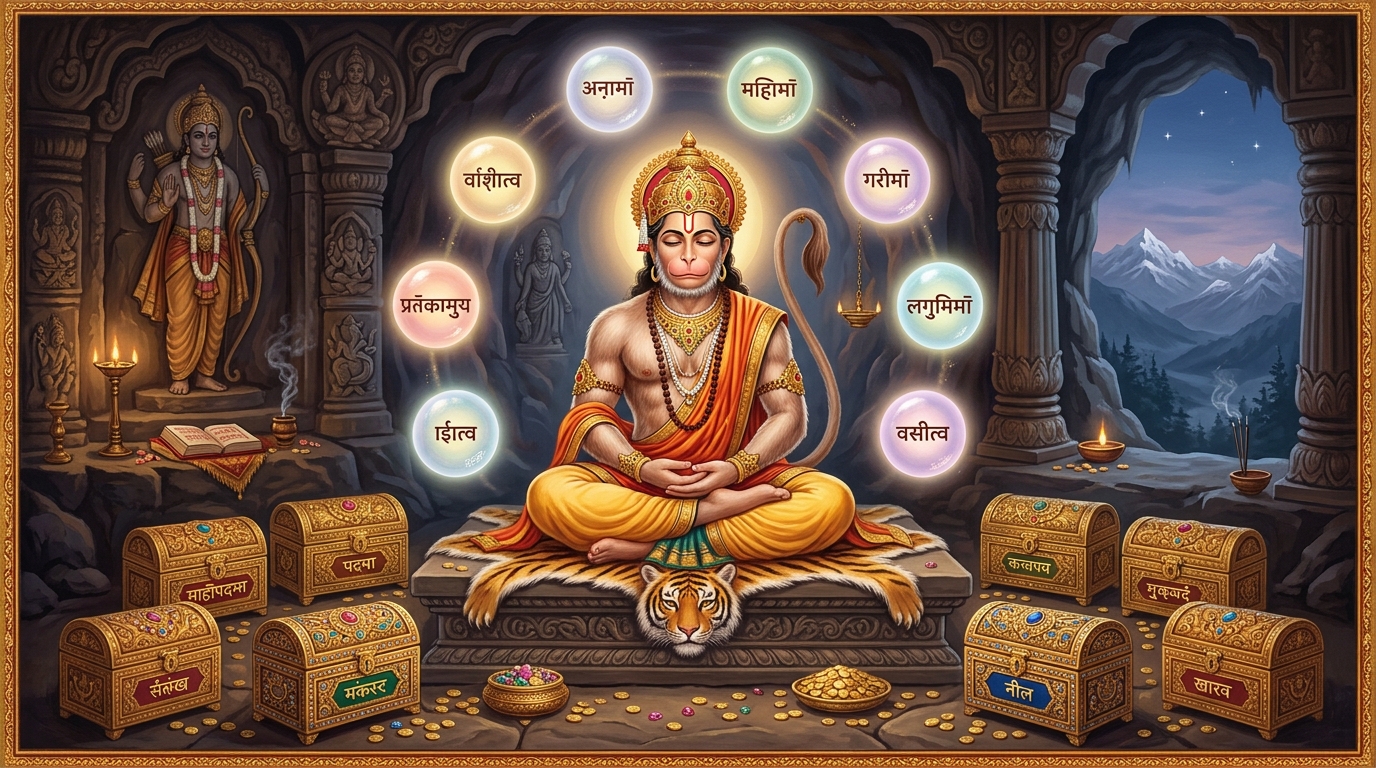
🔍 Decoding (Verse 31): “Ashta Siddhi Nau Nidhi Ke Data” — Hanuman can grant the eight supernatural powers (Ashta Siddhis: becoming infinitely small, infinitely large, infinitely light, infinitely heavy, acquiring anything, having unobstructed will, controlling all, and fulfilling all desires) and the nine treasures (Nau Nidhis). But here is the twist — Hanuman himself never uses these powers for personal gain. He possesses everything yet desires nothing. This is the ultimate freedom.
🔍 Decoding (Verse 33): “Tumhare Bhajan Ram Ko Pave” — Through your devotion, one reaches Ram and forgets the sorrows of countless lifetimes. The word janm janm (birth after birth) points to the Vedantic concept that our current suffering is accumulated across multiple lifetimes. Hanuman bhakti is the solvent that dissolves this karmic residue.
🔍 Decoding (Verse 35): “Aur Devata Chitt Na Dharai” — One need not focus on any other deity. Serving Hanuman alone provides all happiness. This is not exclusivity — it is the principle of ekagrata (one-pointed focus). In a world of infinite distractions, choosing one path and going deep is more powerful than scattering your energy across dozens.
🔸 चौपाई ३६–४० | Chaupai 36-40 — The Final Promise
संकट कटे मिटे सब पीरा। जो सुमिरे हनुमत बलबीरा॥
जय जय जय हनुमान गोसाईं। कृपा करहु गुरु देव की नाईं॥
जो सत बार पाठ कर कोई। छूटहि बंदि महा सुख होई॥
जो यह पढ़े हनुमान चालीसा। होय सिद्धि साखी गौरीसा॥
तुलसीदास सदा हरि चेरा। कीजे नाथ हृदय महँ डेरा॥
Sankat Kate Mite Sab Peera… Tulsidas Sada Hari Chera, Kije Nath Hriday Mah Dera.
🔍 Decoding (Verse 38): “Jo Sat Bar Path Kar Koi, Chhutahi Bandi Maha Sukh Hoi” — Whoever recites this a hundred times will be freed from all bondages and will experience supreme bliss (maha sukh). As Acharya Prashant explains from the Vedantic perspective, this maha sukh is not ordinary happiness — it is Ananda, the unconditional bliss that comes from liberation from all bondages. The bondages are not chains on the body — they are chains on the mind: fear, greed, jealousy, attachment.
🔍 Decoding (Verse 39): “Jo Yah Padhe Hanuman Chalisa, Hoy Siddhi Sakhi Gaurisa” — Whoever reads the Hanuman Chalisa will attain spiritual perfection, and Lord Shiva himself is the witness to this promise. Gaurisa = Gauri (Parvati) + Isha (Lord) = Shiva. The significance is immense — the guarantee of the Chalisa’s effectiveness comes from Shiva himself, the highest authority in the cosmos.
🔍 Decoding (Verse 40): “Tulsidas Sada Hari Chera, Kije Nath Hriday Mah Dera” — Tulsidas says: I am forever a servant of God. O Lord, please make your abode in my heart. This is the final verse and it is Tulsidas speaking in first person — dropping all pretense, all scholarly apparatus, simply saying: I belong to you. Please live in my heart. The entire 40-verse journey culminates in this one request — not for wealth, not for power, not for fame — just for the divine presence within.
📿 The Closing Doha — The Eternal Refuge
पवन तनय संकट हरन, मंगल मूरति रूप।
राम लखन सीता सहित, हृदय बसहु सुर भूप॥
Pavan Tanay Sankat Haran, Mangal Murti Roop,
Ram Lakhan Sita Sahit, Hriday Basahu Sur Bhoop.
📖 Translation: “O Son of the Wind, destroyer of all sorrows, embodiment of all that is auspicious — along with Rama, Lakshmana, and Sita, please reside in my heart, O king of the gods.”
🔍 Final Decoding: The Chalisa ends where it began — with a request for the divine to dwell within. Hriday basahu — please live in my heart. Not in a temple, not in a book, not in the sky — in my heart. This is the essence of Sanatan Dharma: God is not somewhere out there to be found. God is already within, waiting to be recognized. The entire Hanuman Chalisa is a 40-step journey from cleansing the mirror of the mind (Doha 1) to discovering that the divine was always already present in the heart (Closing Doha).
🔬 Why Modern Science Validates Hanuman Chalisa Chanting
Research in neuroplasticity and psychoacoustics has shown that repetitive chanting activates the parasympathetic nervous system, reduces stress hormones like cortisol, and increases gamma-wave brain activity associated with heightened awareness and compassion. The rhythmic structure of the Chalisa — its consistent meter and rhyme scheme — creates a meditative entrainment effect, synchronizing brainwaves into coherent patterns. What Tulsidas designed 500 years ago, modern science is only now beginning to understand.
📋 Quick Reference: Complete Hanuman Chalisa Structure
Opening Doha (1): Invocation of the Guru, purification of mind, praise of Lord Rama
Opening Doha (2): Acknowledgment of human limitation, prayer for strength, wisdom, and knowledge
Chaupai 1-6: Description of Hanuman’s divine attributes — wisdom, strength, beauty, lineage
Chaupai 7-10: Hanuman’s devotion to Ram and his legendary deeds (burning Lanka, three forms)
Chaupai 11-15: The Sanjeevani episode, cosmic recognition of Hanuman’s greatness
Chaupai 16-20: Hanuman’s impact on others (Sugreeva, Vibhishana), swallowing the sun, making the impossible possible
Chaupai 21-25: Hanuman as protector, healer, and guardian at Ram’s door
Chaupai 26-30: Liberation through devotion, timeless glory across all four yugas
Chaupai 31-35: Ashta Siddhis and Nau Nidhis, one-pointed devotion as the path to Ram
Chaupai 36-40: The final promise — liberation from bondage, Shiva’s witness, Tulsidas’s surrender
Closing Doha: Prayer for the divine to reside eternally in the heart
✨ How to Practice Hanuman Chalisa in Daily Life (2026 Guide)
Best Time: Early morning (Brahma Muhurta, 4-6 AM) or after sunset on Tuesdays and Saturdays.
Recommended Practice: Start with one recitation daily. As your connection deepens, you can increase to 7, 11, or 108 recitations during special occasions.
Mindset: Do not recite mechanically. Understand each line. Let the meaning sink in. As the RECALLAI sources emphasize — the Chalisa is designed to cut inner ignorance, not to be repeated like a broken record.
Family Practice: Every Tuesday, sit with your family and recite the Hanuman Chalisa together. This creates a collective field of devotion that is exponentially more powerful than individual practice.
🎯 Conclusion: The Chalisa Is a Mirror, Not Just a Prayer
The Hanuman Chalisa begins by cleansing the mirror of the mind and ends by discovering the divine within the heart. Between these two points, 40 verses paint a portrait of what a fully realized human being looks like — one who is wise yet humble, powerful yet devoted, capable of impossible feats yet interested only in service.
In 2026, as artificial intelligence reshapes our external world, the Hanuman Chalisa offers something no technology can: a blueprint for reshaping the internal world. It is a spiritual operating system — and like all great operating systems, it works best when you understand its source code.
जय श्री राम। जय हनुमान। 🙏
Sources: This deep analysis draws from the RECALLAI knowledge base including Vedantic interpretations by Acharya Prashant, the Om Dhumatkar series on Hanuman Chalisa secrets, and traditional word-by-word meaning compilations. Content curated for Dr. Ananjan’s Astro Intelligence platform.