

Ganpati Atharvashirsha Decoded — 5 Pillars That Reveal the Universe Within You
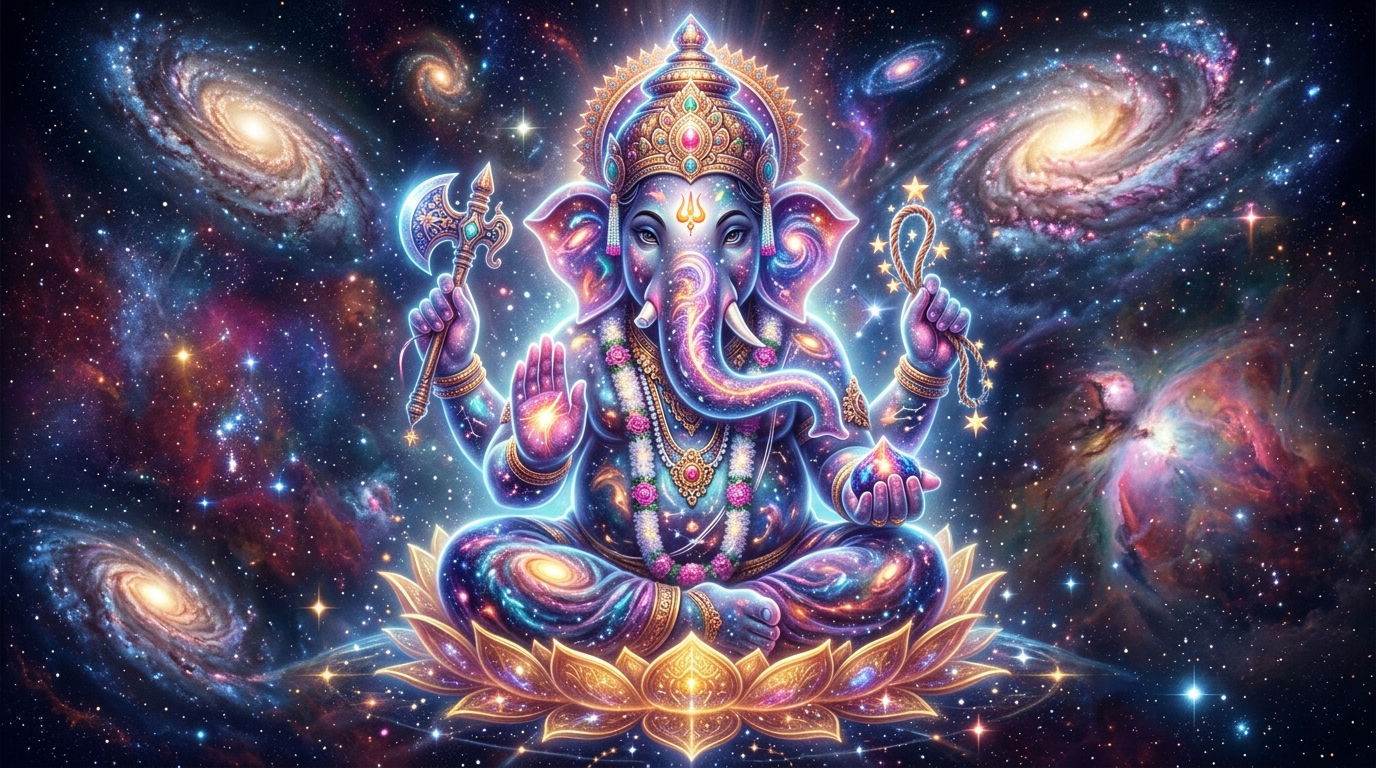
Most people recite the Ganpati Atharvashirsha without ever grasping what it actually says. They hear the Sanskrit syllables rolling off a pandit’s tongue during Ganesh Chaturthi, feel something stir inside, and then move on. But this is not just another prayer. The Atharvashirsha is a Vedic map of the universe disguised as devotion to Ganesha — and once you understand its architecture, you will never recite it the same way again.
In this guide, we decode the entire Ganpati Atharvashirsha through the Five Pillars framework — five foundational ideas that capture the essence of this sacred text. Whether you are a daily practitioner or encountering this Upanishad for the first time, this guide will transform your understanding from ritual recitation into living wisdom.
What Is the Ganpati Atharvashirsha?
The Ganpati Atharvashirsha (also known as the Ganapati Upanishad) is a minor Upanishad attached to the Atharvaveda, one of the four foundational Vedas of Sanatan Dharma. While scholars debate its exact age — some tracing its roots to the Vedic period, others to the 16th or 17th century — its philosophical depth is beyond dispute.
The word “Ganapati” itself appears as early as the Rigveda (c. 2nd millennium BCE), meaning “leader of the multitudes.” But what makes this particular text extraordinary is its central claim: Ganesha is not merely a deity who removes obstacles. He is the Brahman — the ultimate, all-pervading reality from which the entire universe springs, in which it exists, and into which it eventually dissolves.
The text identifies Ganesha with the highest metaphysical concepts in Hindu philosophy — Brahman (the ultimate reality), Atman (the individual soul), Om (the sacred sound of the universe), and the Vedic mahavakya “Tat Tvam Asi” (You are That). It is the most widely recited Sanskrit text among Ganesha devotees in Maharashtra and across India.
The Structure of the Atharvashirsha
Before we dive into the Five Pillars, it helps to understand how the text is organized. The Atharvashirsha flows through several distinct movements, much like a piece of classical music — each building upon the last:
Shanti Mantra (Peace Invocation) — A plea for auspicious hearing, seeing, and living. The devotee asks Indra, Pushan, Garuda, and Brihaspati to grant well-being and peace before the sacred knowledge is transmitted.
The Core Upanishad — The philosophical heart, declaring Ganesha as Brahman, the sole Creator-Sustainer-Destroyer, the embodiment of Satchidananda (Existence-Consciousness-Bliss), and the resident of the Muladhara chakra.
The Ganesha Mantra and Gayatri — The sacred syllable construction (Ga-Na-Pa-Ti) and the Ganesha Gayatri: “Ekadantaya Vidmahe, Vakratundaya Dhimahi, Tanno Dantih Prachodayat.”
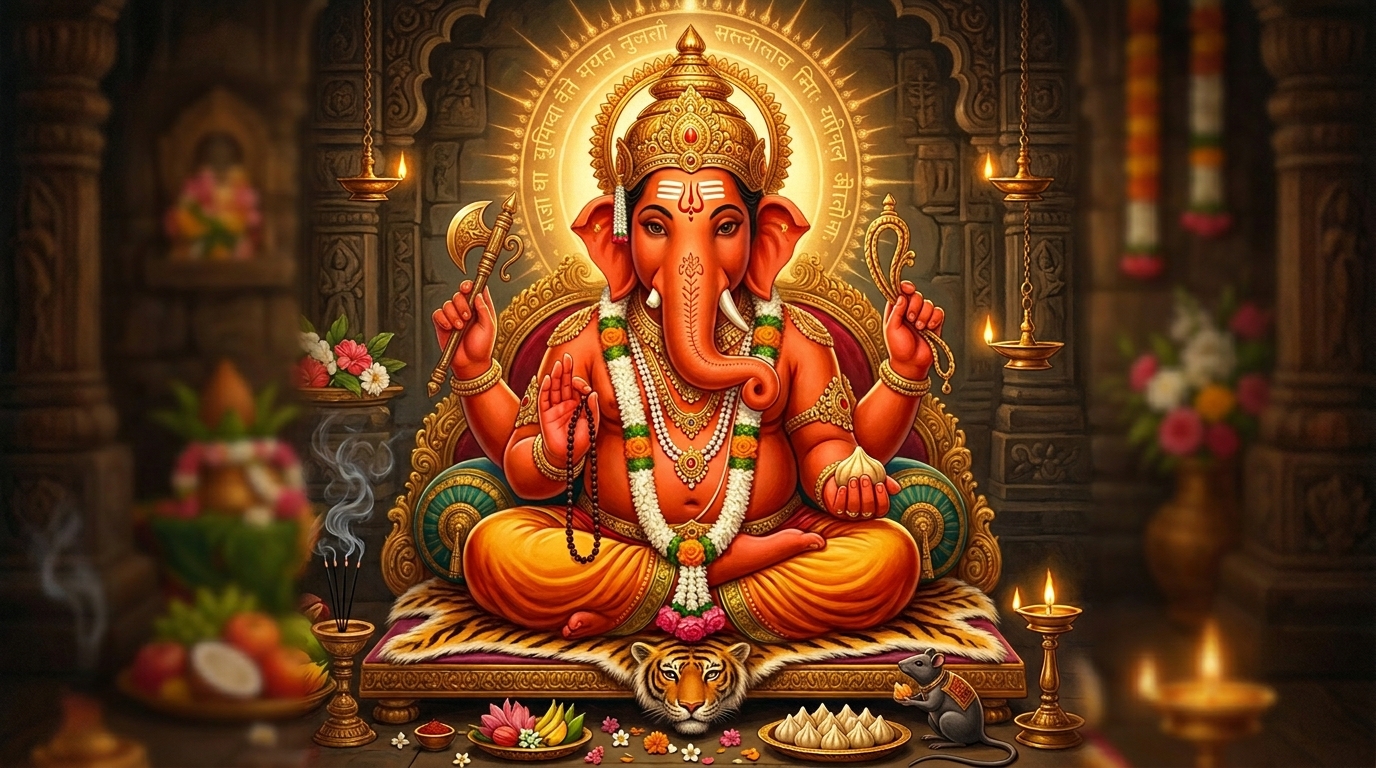
The Dhyana Shloka (Meditation Verse) — A vivid description of Ganesha’s form for meditation: one-tusked, four-armed, holding a noose and goad, red-complexioned, with a generous belly and large ears.
Phala Shruti (Benefits of Recitation) — The concluding section describing the spiritual fruits: removal of obstacles, purification of sins, intellectual growth, and ultimately, becoming one with Brahman.
The Five Pillars: A Storytelling Framework
The Atharvashirsha is dense. To make its wisdom accessible, we can distill the entire text into five foundational pillars. Each pillar contains a core Sanskrit verse, its philosophical meaning, and a modern story to bring it alive.
Pillar 1 — The Visible Reality: “Twameva Pratyaksham Tattvamasi”
The Sanskrit: ॐ नमस्ते गणपतये। त्वमेव प्रत्यक्षं तत्त्वमसि।
The Meaning: “Om, salutations to Lord Ganesha. You alone are the visible manifestation of the Ultimate Reality.”
This is perhaps the most radical statement in the entire text. “Tattvamasi” — “You are That” — is one of the four great Mahavakyas (grand pronouncements) of the Upanishads. By applying it directly to Ganesha, the Atharvashirsha is saying: the infinite, formless Brahman that your mind cannot grasp has taken a form you can grasp. Ganesha is not a symbol of Brahman. He is Brahman, made visible.
The Story: Imagine you are standing before a vast, ancient ocean. You want to understand what “water” really is — its depth, its power, its mystery. You could read oceanography textbooks for a lifetime and still not feel it. But when a single wave crashes at your feet and the cold water wraps around your ankles, in that instant, you know the ocean.
Ganesha is that wave. The universe is too vast for the human mind to comprehend. But when you look at Ganesha — with his elephant head that represents cosmic wisdom, his large ears that listen to everything, his broken tusk that symbolizes sacrifice, and his calm eyes that see through illusion — you are touching the infinite through a form your heart can hold.
The Lesson: You do not need to become a Vedantic scholar to touch the divine. Even if philosophy confuses you, even if Sanskrit feels foreign — simply focusing on Ganesha’s form with devotion automatically connects you to the formless ocean of Brahman. The wave is the ocean.

Pillar 2 — The Potter of Life: “Karta-si, Dharta-si, Harta-si”
The Sanskrit: त्वमेव केवलं कर्ताऽसि। त्वमेव केवलं धर्ताऽसि। त्वमेव केवलं हर्ताऽसि। त्वमेव सर्वं खल्विदं ब्रह्मासि।
The Meaning: “You alone are the sole Creator. You alone are the sole Sustainer. You alone are the sole Destroyer. You are indeed the entire Brahman.”
This trinity of creation-sustenance-destruction is usually attributed to Brahma-Vishnu-Shiva. But the Atharvashirsha collapses all three into Ganesha alone. Later in the text, it reinforces this: “Twam Brahma, Twam Vishnu, Twam Rudra” — You are Brahma, You are Vishnu, You are Rudra. Ganesha is not one member of the trinity; he is the source from which the trinity itself emerges.
The Story: Think of a master potter working with clay. First, the potter takes raw earth and shapes it into a beautiful jar — this is Karta, the Creator. Then the potter places the jar on a shelf, protects it, ensures it can hold water for people to drink — this is Dharta, the Sustainer. Years later, when the jar is cracked and has served its purpose, the potter breaks it down so the clay can be remade into something new and even more beautiful — this is Harta, the Destroyer.
The Lesson: Ganesha is the Potter of your life. Every new idea that sparks in your mind is Ganesha creating. Every morning you wake up and your heart is still beating — that is Ganesha sustaining you. Every time a bad habit finally breaks, a toxic relationship finally ends, or an old chapter of your life finally closes — that is Ganesha destroying the old to make room for the new. You are never alone, because the Potter is always working on you.

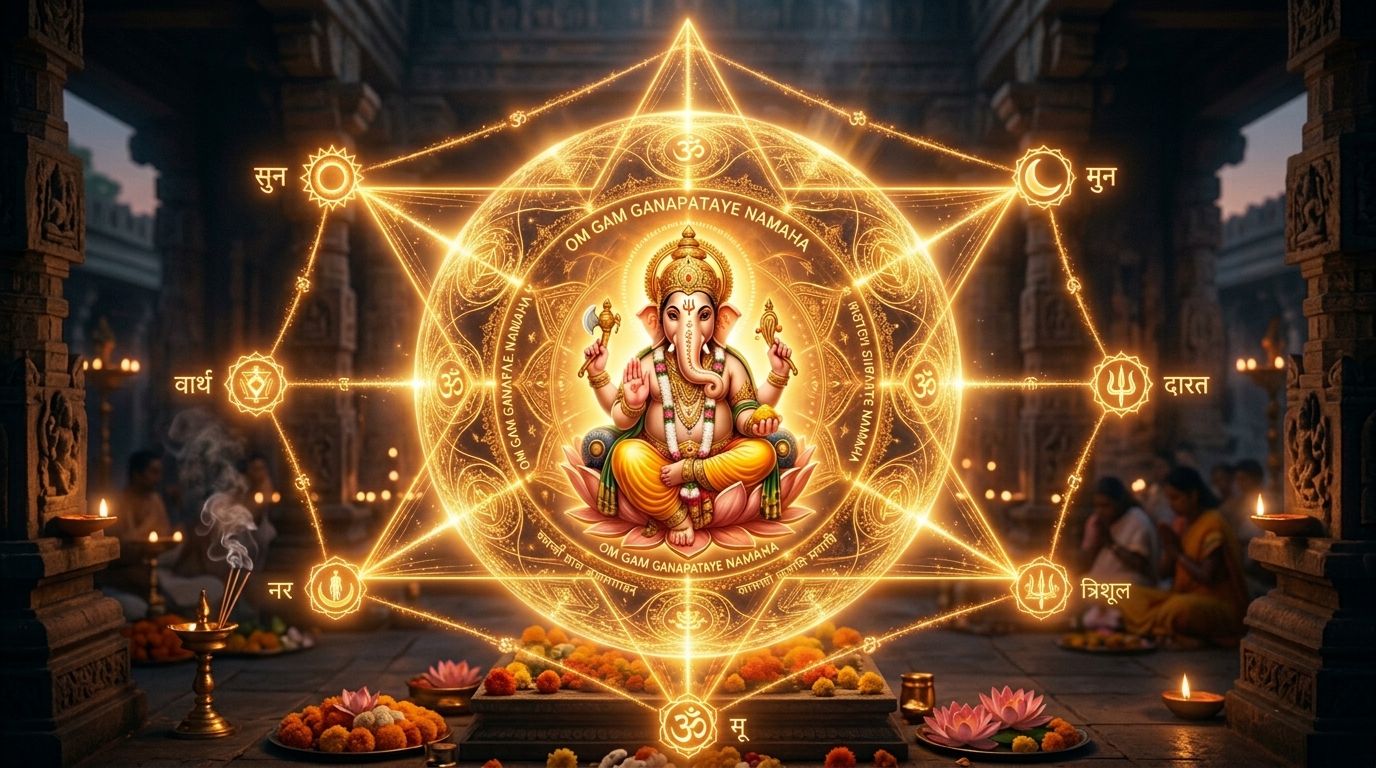
Pillar 3 — The Spiritual Bodyguard: “Sarvato Mam Pahi Pahi Samantat”
The Sanskrit: अव पश्चात्तात्। अव पुरस्तात्। अवोत्तरात्तात्। अव दक्षिणात्तात्। अव चोर्ध्वात्तात्। अवाधरात्तात्। सर्वतो मां पाहि पाहि समन्तात्।
The Meaning: “Protect me from behind. Protect me from the front. Protect me from the north. Protect me from the south. Protect me from above. Protect me from below. Protect me from all sides, protect me completely.”
This is one of the most emotionally powerful sections of the Atharvashirsha. Before this, the text also asks: “Protect me, protect the speaker, protect the listener, protect the teacher, protect the student.” The protection is not just personal — it extends to everyone involved in the transmission of sacred knowledge.
The Story: Imagine a small child walking through a crowded, noisy carnival. The lights are blinding, the sounds are overwhelming, strangers are pressing in from every direction. The child is terrified. But then the father appears — walking right behind the child, his hands gently resting on the child’s shoulders. The father clears the path ahead, watches the sides, makes sure nobody bumps into the child from behind. The child cannot see the father’s face, but feels the warm hands and knows: I am safe.
The Lesson: When you feel vulnerable — confused by life, anxious about the future, haunted by the past — you feel like that child in the carnival. This section of the Atharvashirsha is a request for a “spiritual bubble.” When you chant “Sarvato Mam Pahi Pahi Samantat,” imagine a golden light surrounding you from every direction — blocking negative thoughts from the past (behind), worries about the future (front), criticism from peers (sides), existential dread (above), and self-doubt from within (below). Ganesha is your bodyguard, and his protection is omnidirectional.
Pillar 4 — The Lightbulb of Consciousness: “Twam Vangmayas-Twam Chinmayah”
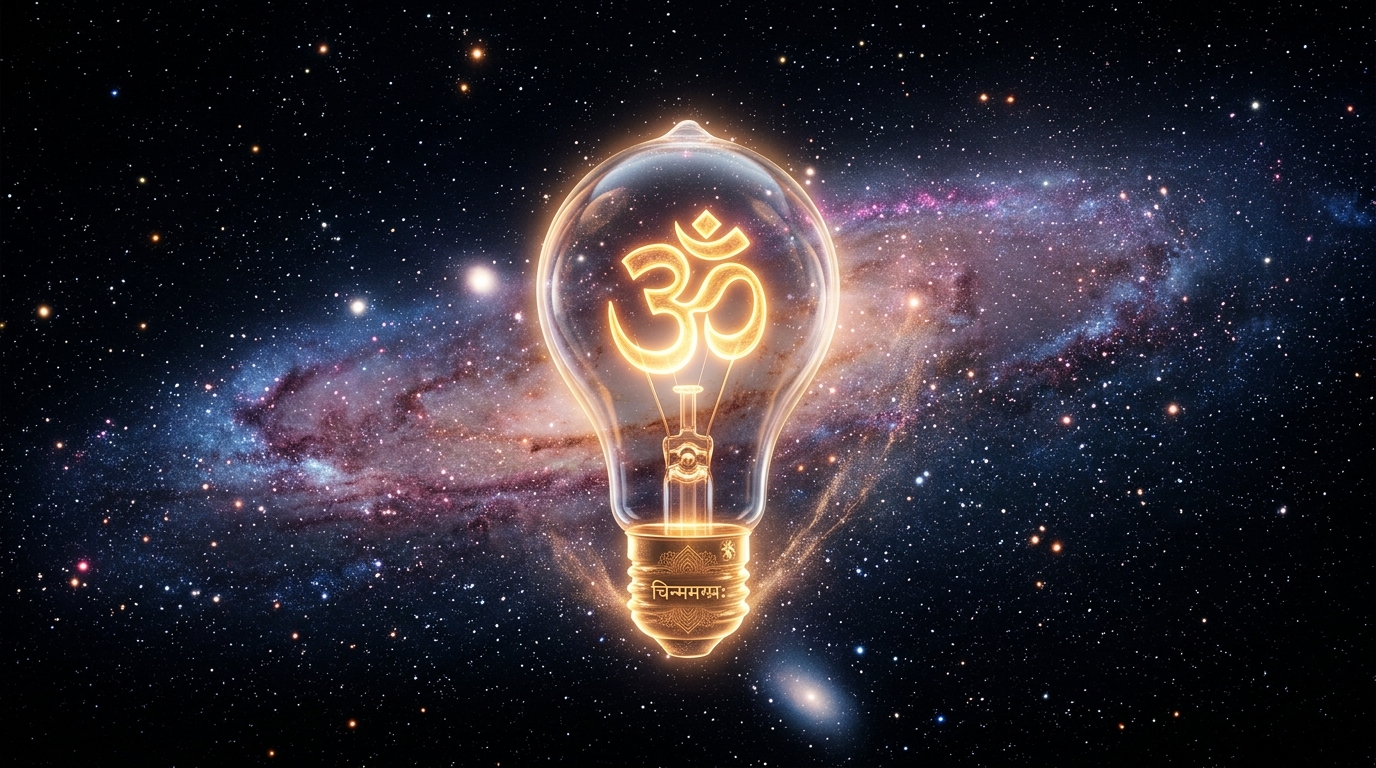
The Sanskrit: त्वं वाङ्मयस्त्वं चिन्मयः। त्वमानन्दमयस्त्वं ब्रह्ममयः। त्वं सच्चिदानन्दाद्वितीयोऽसि। त्वं प्रत्यक्षं ब्रह्मासि। त्वं ज्ञानमयो विज्ञानमयोऽसि।
The Meaning: “You are composed of speech. You are composed of pure consciousness. You are full of bliss. You are full of the Supreme Spirit. You are the non-dual Existence-Consciousness-Bliss (Satchidananda). You are the visible Brahman. You are the embodiment of knowledge and wisdom.”
This is the philosophical summit of the Atharvashirsha. The text packs the entire Vedantic framework — Sat (existence), Chit (consciousness), Ananda (bliss) — into a single identity: Ganesha. He is not just full of bliss; he is bliss. He is not just knowledgeable; he is knowledge itself made manifest.
The Story: Think of a lightbulb. The Chinmayah (pure consciousness) is the electricity — the invisible power humming through the wires that makes everything work. You cannot see electricity, you cannot hold it, but without it, the room is dark. The Vangmayah (speech, expression) is the light that radiates outward — the way that invisible power reveals itself to the world, illuminating every corner of the room.
The Lesson: You might sometimes feel “dull” or unintelligent. You might wonder why wisdom seems to come easily to others but not to you. This verse says something radical: you are made of the same “electricity” as Ganesha. Your ability to speak, to think, to question, to even feel confused — all of it is Ganesha’s consciousness moving through you. You are not a “dull person.” You are a bright lightbulb that simply needs to be plugged into the right socket. The Atharvashirsha is that socket.
Pillar 5 — The Deep Roots: “Twam Muladhara Sthito-si Nityam”
The Sanskrit: त्वं मूलाधारस्थितोऽसि नित्यम्। त्वं शक्तित्रयात्मकः। त्वां योगिनो ध्यायन्ति नित्यम्।
The Meaning: “You reside eternally at the Muladhara (root). You are the embodiment of three powers (Shakti). Yogis meditate upon You constantly.”
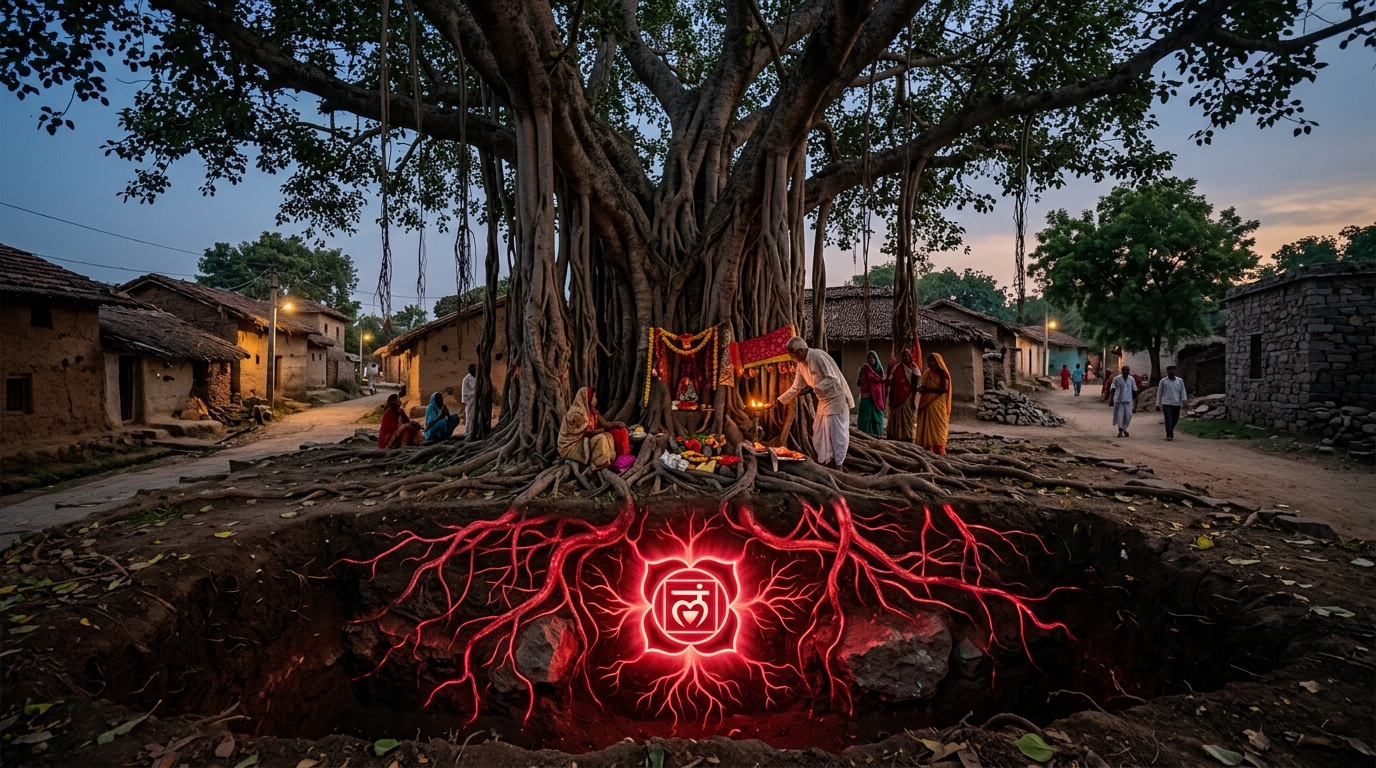
The Muladhara is the root chakra located at the base of the spine — the very foundation of the human energy system in yogic philosophy. It governs stability, survival, security, and primal memory. By declaring that Ganesha eternally resides here, the Atharvashirsha reveals why Ganesha is invoked first before any undertaking: he is the foundation upon which everything else is built. Without stable roots, no tree can grow, no temple can stand, no life can flourish.
The Story: Think of a giant Banyan tree — the kind you see in the heart of Indian villages, with roots thick as pillars and a canopy that shelters an entire community. That tree has weathered monsoons, droughts, storms, and centuries. Why does it still stand? Because its roots run deep into the earth. While the branches sway and leaves fall, the roots remain unshaken.
The Lesson: Ganesha is your internal root system. When life feels shaky — when you lose a job, face a health scare, or feel groundless in a changing world — it is because you have temporarily forgotten your roots. By chanting this verse, you are “watering your roots,” reconnecting to the deepest foundation of your being. The yogis who meditate on Ganesha at the Muladhara know this: external storms cannot topple a person whose roots touch the infinite.
The Complete Sanskrit Text with Line-by-Line Meaning
Now that the Five Pillars have given you the philosophical map, here is the complete text decoded section by section.
Shanti Mantra (Peace Invocation)
ॐ भद्रं कर्णेभिः शृणुयाम देवाः — O Gods, may we hear what is auspicious with our ears.
भद्रं पश्येमाक्षभिर्यजत्राः — O worshipful ones, may we see what is auspicious with our eyes.
स्थिरैरङ्गैस्तुष्टुवांसस्तनूभिः — May we, with strong limbs and bodies, offer praise to you.
व्यशेम देवहितं यदायुः — May we enjoy the full lifespan allotted by the Gods.
ॐ स्वस्ति न इन्द्रो वृद्धश्रवाः — May Indra of great fame grant us well-being.
स्वस्ति नः पूषा विश्ववेदाः — May the all-knowing Pushan grant us well-being.
स्वस्ति नस्तार्क्ष्यो अरिष्टनेमिः — May Tarksya (Garuda), destroyer of evil, grant us well-being.
स्वस्ति नो बृहस्पतिर्दधातु — May Brihaspati grant us well-being.
ॐ शान्तिः शान्तिः शान्तिः — Om, Peace, Peace, Peace.
The Cosmic Declaration
त्वमेव सर्वं खल्विदं ब्रह्मासि — You are indeed the entire Brahman.
त्वं साक्षादात्मासि नित्यम् — You are the eternal, manifest soul (Atman).
ऋतं वच्मि। सत्यं वच्मि। — I speak the divine law (Ritam). I speak the truth (Satyam).
The Source of All Creation
सर्वं जगदिदं त्वत्तो जायते — This entire world is born from You.
सर्वं जगदिदं त्वत्तस्तिष्ठति — This entire world stays within You.
सर्वं जगदिदं त्वयि लयमेष्यति — This entire world will dissolve back into You.
त्वं भूमिरापोऽनलोऽनिलो नभः — You are Earth, Water, Fire, Air, and Space — the five elements.
त्वं गुणत्रयातीतः — You transcend the three Gunas (Sattva, Rajas, Tamas).
त्वं कालत्रयातीतः — You transcend the three divisions of time (past, present, future).
त्वं देहत्रयातीतः — You transcend the three bodies (gross, subtle, causal).
The Phala Shruti: Benefits of Reciting the Atharvashirsha
The concluding section of the Atharvashirsha is remarkably specific about the rewards of practice. These are not vague promises — they are structured outcomes mapped to specific actions.
Immediate spiritual effects: The text states that whoever studies this Atharvashirsha becomes fit to realize Brahman (Sa Brahmabhuyaya Kalpate). All obstacles fall away. The five great sins are dissolved. Morning recitation destroys sins accumulated at night; evening recitation purifies the actions of the day.
Intellectual growth: Regular practitioners are said to become Vidhyavan (knowledgeable) and Medhavan (sharp-minded). Those who perform Abhisheka (ritual bathing of the Ganesha idol) while reciting become Vagmi — eloquent speakers.
The four life goals: The practitioner achieves all four Purusharthas — Dharma (righteousness), Artha (wealth), Kama (fulfillment of desires), and Moksha (liberation).
Specific offerings and their fruits: Offering Durva grass brings wealth and prosperity. Offering parched grain (Laja) brings fame and intelligence. Offering Modaks (sweets) helps achieve desired goals. Reciting during a solar eclipse near a great river makes the mantra Siddha — fully perfected and activated for the practitioner.
Radiance: A person who recites the Atharvashirsha after initiation by eight Brahmins becomes Suryavarchasvi — radiant as the sun.
When and How to Practice
The Atharvashirsha itself prescribes specific times and methods for maximum benefit.
Morning (Pratar-adhyayana): Reciting at dawn destroys sins of the previous night and sets a clear, obstacle-free intention for the day ahead. This is the most recommended time for beginners.
Evening (Sayam-adhyayana): Reciting at dusk purifies any negativity accumulated during the day’s activities. Those who practice both morning and evening become Apapo — completely free from sin.
Chaturthi: Reciting while fasting on the fourth day of the lunar fortnight (Chaturthi) is considered especially potent for intellectual growth and worldly success.
For beginners: If the Sanskrit feels overwhelming, start simply by listening to a clear recitation — the version by Suresh Wadkar is widely considered one of the finest. Focus not on pronunciation perfection but on the “stories” behind the verses — the wave, the potter, the bodyguard, the lightbulb, the roots. Understanding transforms recitation from mechanical ritual into living meditation.
The Summary for the Modern Seeker
You do not need to be a Sanskrit scholar or a lifelong devotee to receive the Atharvashirsha’s gifts. If the philosophy feels dense, hold onto just three things from the Five Pillars:
Ganesha is the Ocean in a single wave. You do not need to understand the infinite — just look at the form, and the formless reveals itself.
Ganesha is the Bodyguard walking with you in the carnival of life. When fear closes in from every direction, this prayer wraps you in a shield of light.
Ganesha is the Root that keeps you standing when life feels shaky. He lives at the very base of your spine, the foundation of your energy system. Water your roots, and no storm can topple you.
Even if you do not know the Sanskrit perfectly, even if you only listen and let the sound wash over you while holding these stories in your heart — the Atharvashirsha will do its work. It will clear the mind, remove the obstacles, and reconnect you to the deepest, most unshakeable part of yourself.
ॐ शान्तिः शान्तिः शान्तिः
Om Shanti, Shanti, Shanti.